

Just Accepted
Just Accepted Articles have been posted online after technical editing and typesetting for immediate view. The final edited version with page numbers will appear in the Current Issue soon.
Submit a Manuscript

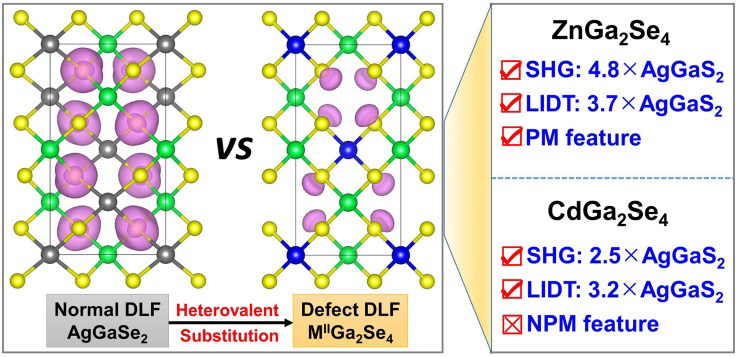
From AgGaSe2 to MIIGa2Se4 (MII = Zn, Cd): Heterovalent substitution creates ordered vacancies for balanced IR-NLO performance
Hong Chen, Zheng-Tao Hu b, Mao-Yin Ran, Zuju Ma*, Xin-Tao Wu, Hua Lin*
https://doi.org/10.1016/j.cjsc.2026.101108
MIIGa2Se4 (MII = Zn, Cd); IR nonlinear optical; Defect-diamond-like structure; Heterovalent substitution; Ordered vacancies
ABSTRACT
The concurrent achievement of strong second-harmonic generation (SHG) and high laser-induced damage threshold (LIDT) in a single infrared nonlinear optical (IR-NLO) material is fundamentally constrained by different electronic-structure requirements. Herein, we propose a heterovalent substitution strategy that introduces ordered cation vacancies to synergistically optimize the IR-NLO performance of famous chalcopyrite structure AgGaSe2. Guided by this design, we successfully synthesized two ternary defect-diamond-like selenides, MIIGa2Se4 (MII = Zn, Cd). Both compounds belong to the I space group and exhibit well balanced SHG coefficients and LIDT values: for ZnGa2Se4, 4.8 × AgGaS2 and 3.7 ×AgGaS2, respectively, ranking it among the best Zn-based IR-NLO materials reported to date; for CdGa2Se4, 2.5 × AgGaS2 and 3.2 ×AgGaS2, respectively, positioning them as promising IR-NLO candidates. Notably, the two compounds display distinctly different phase-matching behaviors at 2900 nm, where ZnGa2Se4 is phase-matchable whereas CdGa2Se4 is not, underscoring the profound impact of cation substitution on optical anisotropy. First-principles calculations based on the length-gauge formalism reveal that the synergistic effect of vacancy defects and the ordered alignment of tetrahedral [MIISe4] and [GaSe4] units serve as the main drivers of the enhanced SHG response. This work demonstrates that vacancy engineering within the chalcopyrite-derived diamond-like framework offers a viable route to mitigate the SHG–LIDT trade-off in IR-NLO chalcogenides.




- Address: Fuzhou High & New Technology Industrial Zone, Shangjie, Minhou, Fuzhou, Fujian 350108, China
- Tel: (86)-591-63173769, 63173770
- E-mail: cjsc@fjirsm.ac.cn
CN 35–1112/TQ, ISSN 0254–5861, Online ISSN: 2949-768X Copyright @ 2022 Chinese Journal of Structural Chemistry-www.Chinese Journal of Structural Chemistry.net. All Rights Reserved 闽ICP备2022002645号-1