

Just Accepted
Just Accepted Articles have been posted online after technical editing and typesetting for immediate view. The final edited version with page numbers will appear in the Current Issue soon.
Submit a Manuscript

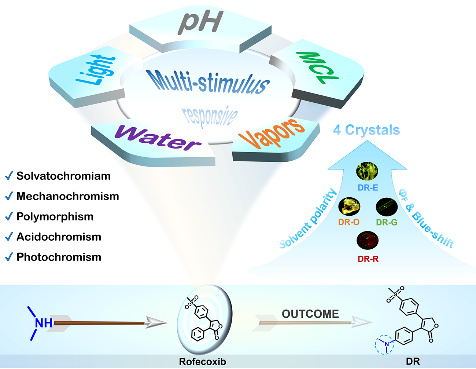
Dimethylamino Rofecoxib with four polymorphic crystals as a new multi-stimulus responsive material
Yanbing Ke#, Xia Wang #, Tong Wu#, Wei Liu, Yongbo Wei, Hongmei Wu, Bing Xu, Fangfei Lu, Hong Chen, Shijie Zhen*, Bin Zheng*, Xinli Wang*, and Lijun Xie*
https://doi.org/10.1016/j.cjsc.2026.101109
Rofecoxib; Multi-stimulus responsive; D-A system; Polymorphic
ABSTRACT
A new multi-stimulus responsive (MSR) material Dimethylamino-Rofecoxib (DR) is successfully developed by introducing a dimethylamino group at the terminal position of the benzene π-system of rofecoxib. The simple modification of a classic pharmaceutical scaffold yields intriguing polymorphic multi-stimuli responsive materials with red-orange luminescence and a molecular weight below 400, thereby exemplifying the advantage of atom economy. Unlike the anti-parallel arrangement observed in rofecoxib crystals, the incorporation of the dimethylamino group results in looser molecular packing. The chemical calculation results show multiple energy wells in the molecular dihedral angle energy landscape, giving rise to various low-energy spatial conformations. After that, these conformations are experimentally obtained via four crystal polymorphs (DR-R, DR-O, DR-Y, and DR-E), each exhibits unique fluorescence behaviors. Moreover, conformational transitions can be triggered by external stimuli. The relationship among p-π conjugation, molecular conformations, stimuli, and fluorescence properties was investigated. Overall, this modification strategy provides a feasible approach to develop multi-stimuli-responsive materials from classical drug scaffolds.




- Address: Fuzhou High & New Technology Industrial Zone, Shangjie, Minhou, Fuzhou, Fujian 350108, China
- Tel: (86)-591-63173769, 63173770
- E-mail: cjsc@fjirsm.ac.cn
CN 35–1112/TQ, ISSN 0254–5861, Online ISSN: 2949-768X Copyright @ 2022 Chinese Journal of Structural Chemistry-www.Chinese Journal of Structural Chemistry.net. All Rights Reserved 闽ICP备2022002645号-1