

Just Accepted
Just Accepted Articles have been posted online after technical editing and typesetting for immediate view. The final edited version with page numbers will appear in the Current Issue soon.
Submit a Manuscript

Unraveling the defect-induced mechanoluminescence via K+/Bi3+ substitution in Na2ZnGeO4:Mn2+ phosphor
Huimin Chen*, Pei Wang*, Zefeng Li, Tao Chai, Long Wang, Yingying Wang, Huijie Wang, and Guojun Zhou*
https://doi.org/10.1016/j.cjsc.2026.101106
Mechanoluminescence; Defect states; Cation substitution; Self-reduction reaction
ABSTRACT
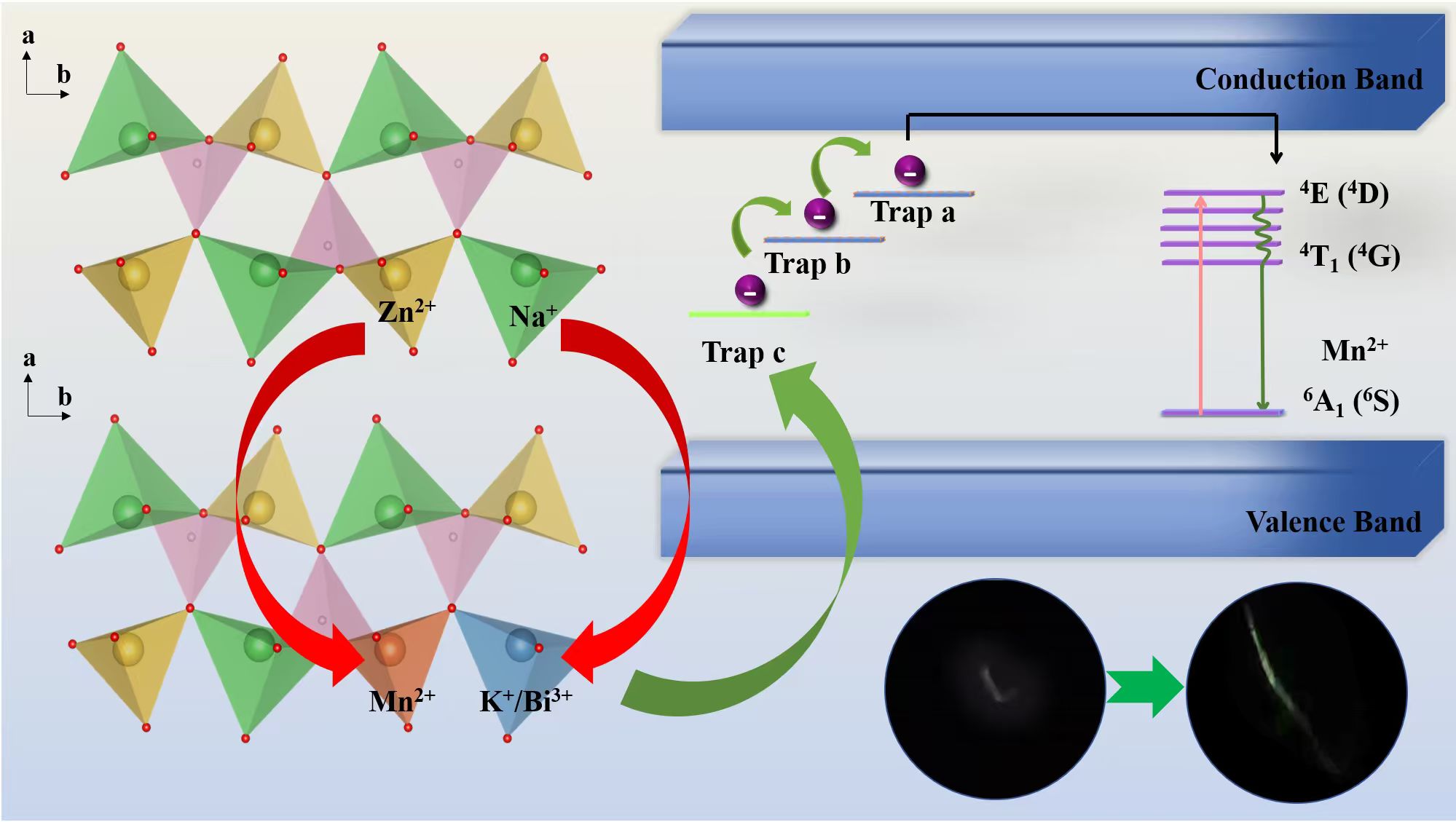
Mechanoluminescent (ML) materials are promising for stress sensing, anti-counterfeiting, and optical storage, where lattice defects play a central role in governing ML performance. Herein, we demonstrate a defect-engineering strategy in Na2ZnGeO4:xMn2+ by K+/Bi3+ substitution to unravel the defect-induced ML mechanism. Upon the incorporation of K+ and Bi3+, additional deeper trap levels were formed beyond the intrinsic trap levels of Na2ZnGeO4:Mn2+, which significantly enhances the carrier storage capability. The material is synthesized via solid-state reaction, during which interstitial oxygen defects facilitate the self-reduction of Mn4+ to luminescent Mn2+ centers, as verified by electron spin resonance and X-ray photoelectron spectroscopy. Thermoluminescence (TL) analysis reveals that both intrinsic and doping-induced traps serve as carrier reservoirs, from which mechanically released carriers are transferred to Mn2+ luminescent centers to produce ML. The additional deep traps introduced by K+/Bi3+ substitution enhance carrier storage and facilitate their subsequent release under mechanical stimulation, thereby accounting for the enhanced ML output. These insights highlight the fundamental role of defect engineering in tuning ML properties. These findings underscore the synergy between cation substitution and defect engineering, providing a robust strategy for designing high-performance ML materials via trap modulation.




- Address: Fuzhou High & New Technology Industrial Zone, Shangjie, Minhou, Fuzhou, Fujian 350108, China
- Tel: (86)-591-63173769, 63173770
- E-mail: cjsc@fjirsm.ac.cn
CN 35–1112/TQ, ISSN 0254–5861, Online ISSN: 2949-768X Copyright @ 2022 Chinese Journal of Structural Chemistry-www.Chinese Journal of Structural Chemistry.net. All Rights Reserved 闽ICP备2022002645号-1