

Just Accepted
Just Accepted Articles have been posted online after technical editing and typesetting for immediate view. The final edited version with page numbers will appear in the Current Issue soon.
Submit a Manuscript

Hydration layer remixing: A new strategy for monovalent cation sieving beyond dehydration
Ruike Zhang, Guocan Yu*, Jiong Zhou*
https://doi.org/10.1016/j.cjsc.2026.101112
ABSTRACT
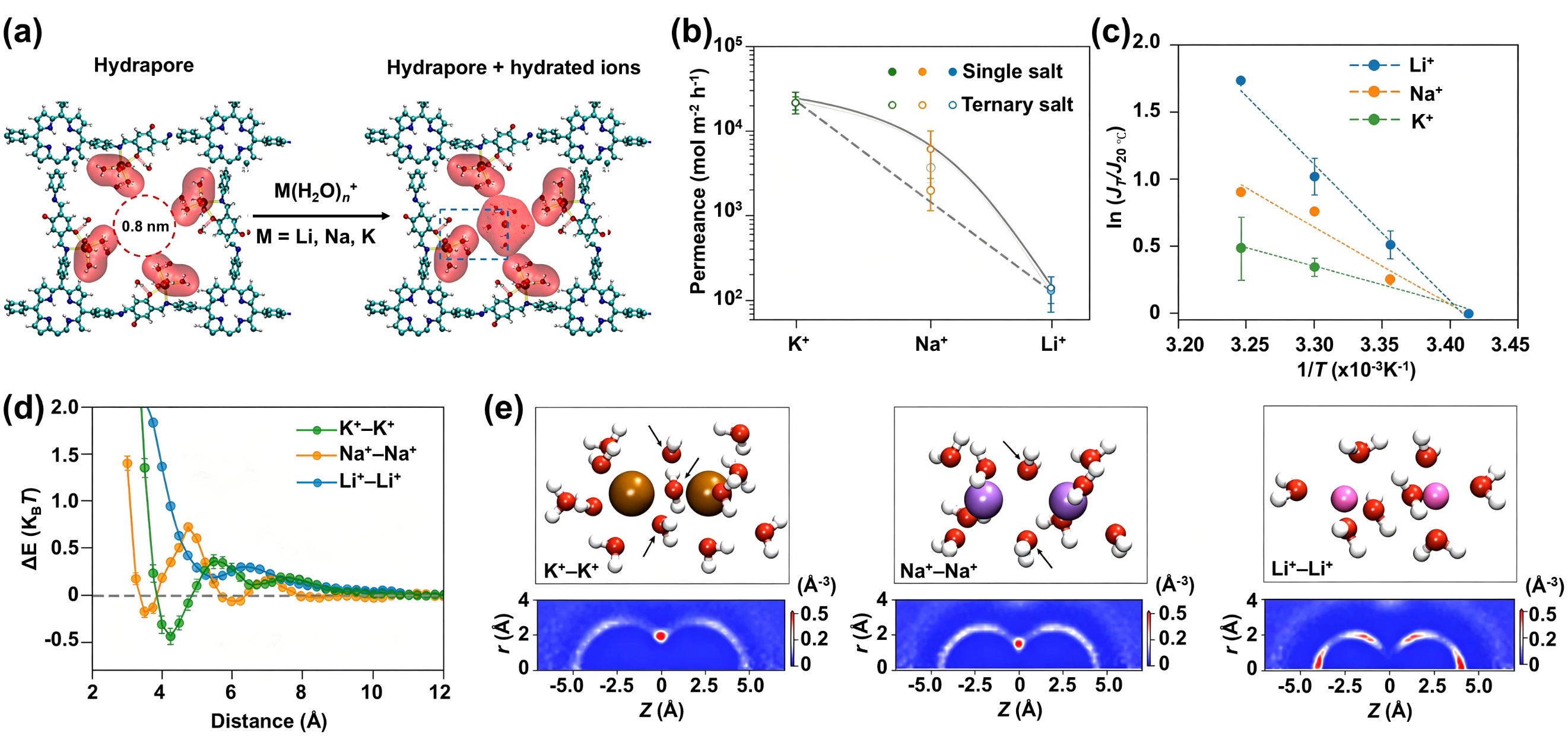
Overall, this study reveals that hydration layers can participate directly in ion recognition and transport regulation. In DHTA-COF, the interplay between ion binding and confined water creates a dynamic hydrapore environment, where differences in hydration layer rearrangement lead to distinct transport behaviors for closely related ions. This concept extends the design of ion selective membranes beyond conventional approaches based on pore size, electrostatic interactions, and dehydration energy. The ability to regulate ion transport through hydration layer interactions suggests a broader strategy for membrane design. Future efforts may explore how different binding environments and pore structures influence confined water organization and ion transport, extending this principle to other challenging separation systems. Such understanding could provide new directions for developing membranes that combine high selectivity with efficient ion transport.




- Address: Fuzhou High & New Technology Industrial Zone, Shangjie, Minhou, Fuzhou, Fujian 350108, China
- Tel: (86)-591-63173769, 63173770
- E-mail: cjsc@fjirsm.ac.cn
CN 35–1112/TQ, ISSN 0254–5861, Online ISSN: 2949-768X Copyright @ 2022 Chinese Journal of Structural Chemistry-www.Chinese Journal of Structural Chemistry.net. All Rights Reserved 闽ICP备2022002645号-1