

Just Accepted
Just Accepted Articles have been posted online after technical editing and typesetting for immediate view. The final edited version with page numbers will appear in the Current Issue soon.
Submit a Manuscript

Ultra-robust silk-based eutectogel enabled by polymeric reconstruction and supramolecular network reinforcement for intelligent bioelectronics
Junlei Wang#, Chunya Wang#*, Zhicheng Nie, Yan Liu, Min Wu, Zhenli Cui, Chunming Xu, Xilong Wang*
https://doi.org/10.1016/j.cjsc.2026.101116
Silk fibroin; Eutectogel; Polymeric reconstruction; Supramolecular reinforcement; Intelligent bioelectronics
ABSTRACT
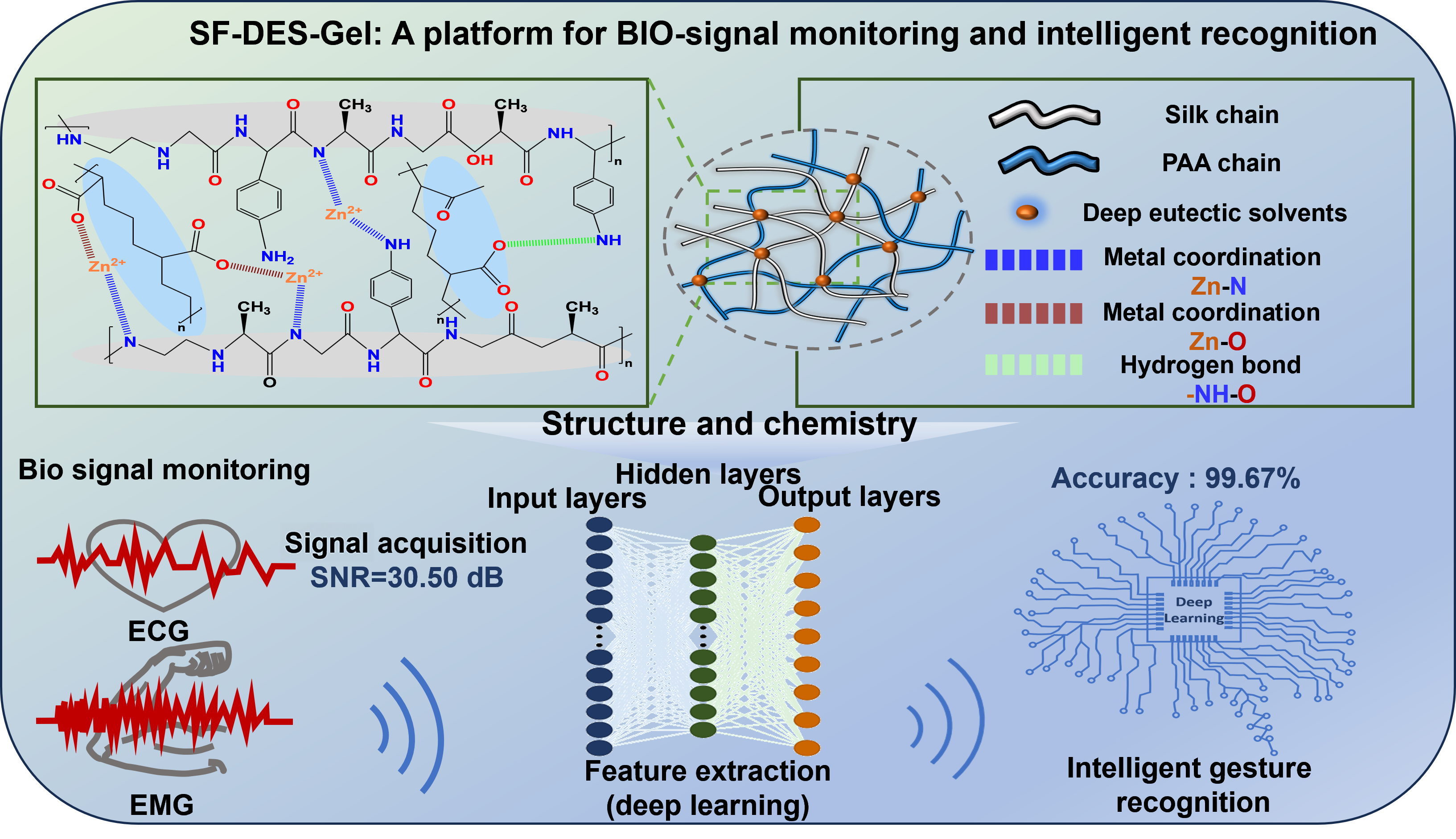
Natural-polymer-derived gel materials are promising candidates for sustainable bioelectronics. Silk fibroin (SF), derived from Bombyx mori, has been widely explored as an advanced biomaterial owing to its chemical processability, biocompatibility, and biodegradability. However, conventional SF-based biogels generally suffer from inadequate mechanical robustness and poor environmental adaptability, restricting their practical applications in intelligent bioelectronics. Moreover, traditional silk processing typically involves time-consuming and energy-intensive dissolution using irritative or toxic chemicals. Herein, we design and fabricate an ultra-robust silk-based eutectogels via a facile one-pot strategy, in which a zinc-based functional deep eutectic solvent (DES) composed of ZnCl2, lactic acid, and acrylic acid is developed to disrupt the compact architecture of silk fibers into an SF dispersion. Concurrently, UV-induced in situ polymerization of acrylic acid within the Zn2+-based DES, without additional photoinitiators or crosslinkers, enables polymeric reconstruction through the integration of SF and poly (acrylic acid) (PAA) phases. More importantly, multiple strong interactions among the DES components and polymeric chains integrate a supramolecular network into the resulting eutectogel, contributing to its mechanical robustness, including a tensile strength of 12.74 MPa, an elongation at break of 1046%, and a toughness of 67.95 MJ m-3, along with remarkable cyclic durability and subzero flexibility. As a proof of concept, the as-designed eutectogel has been demonstrated as an effective biointerface for high-fidelity monitoring of electrocardiogram and surface electromyography (sEMG) signals. Furthermore, an intelligent sEMG sensing system integrated with a deep-learning framework achieves a gesture-recognition accuracy of 99.67%. This work provides a versatile strategy for engineering high-performance biopolymer-based eutectogels toward intelligent bioelectronics.




- Address: Fuzhou High & New Technology Industrial Zone, Shangjie, Minhou, Fuzhou, Fujian 350108, China
- Tel: (86)-591-63173769, 63173770
- E-mail: cjsc@fjirsm.ac.cn
CN 35–1112/TQ, ISSN 0254–5861, Online ISSN: 2949-768X Copyright @ 2022 Chinese Journal of Structural Chemistry-www.Chinese Journal of Structural Chemistry.net. All Rights Reserved 闽ICP备2022002645号-1