

Just Accepted
Just Accepted Articles have been posted online after technical editing and typesetting for immediate view. The final edited version with page numbers will appear in the Current Issue soon.
Submit a Manuscript

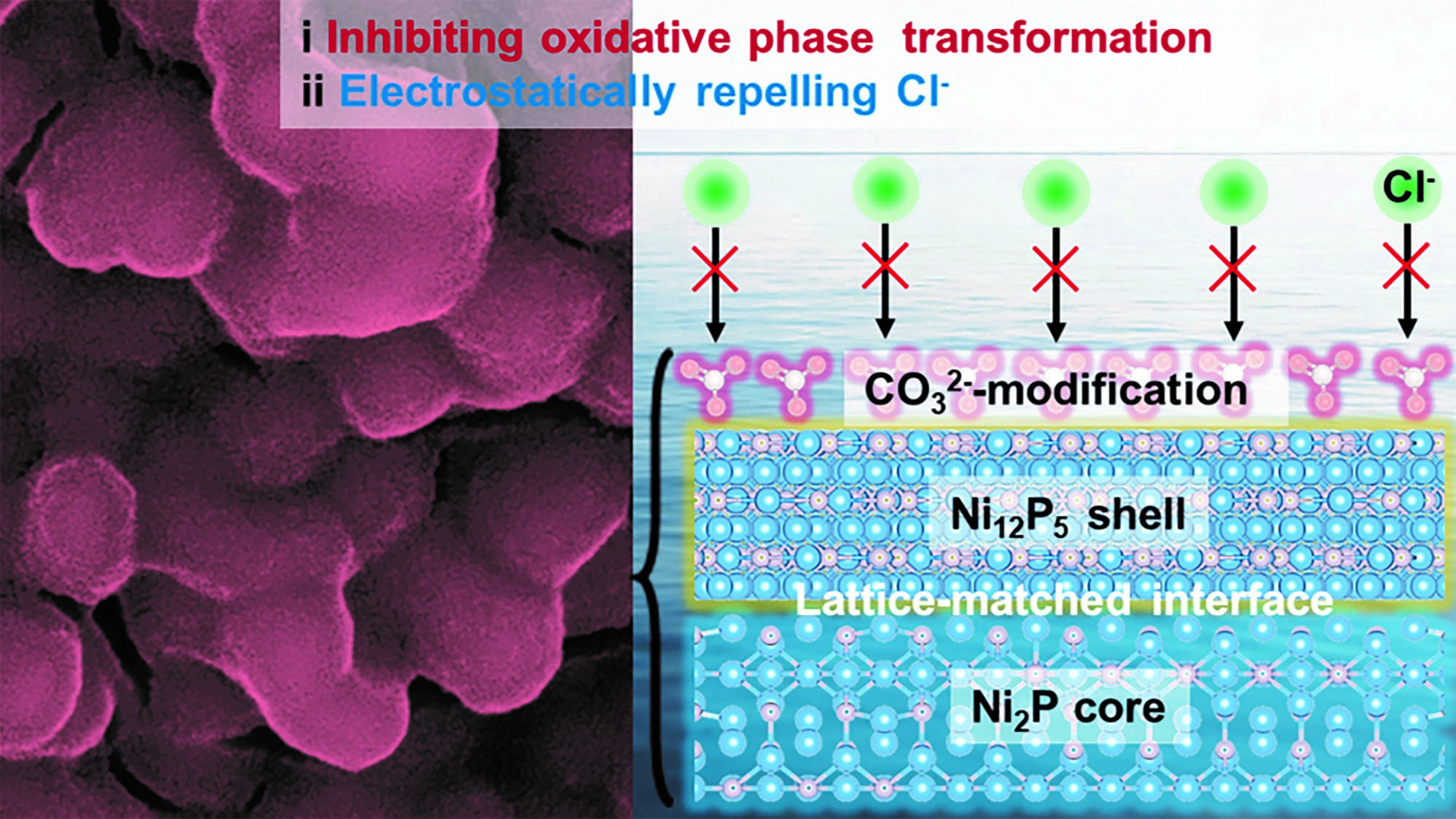
Carbonate-modified CoFe-doped Ni2P@Ni12P5 core-shell heterostructure for ultrastable seawater oxygen evolution
Xingrong Zhang, Wenquan Zhang, Yanru Geng, Xien Liu*, Liqiang Hou*
https://doi.org/10.1016/j.cjsc.2026.101127
Seawater electrolysis; Oxygen evolution reaction; Nickel phosphide; Core-shell structure; Carbonate modification
ABSTRACT
Transition metal phosphides are intrinsically active for the oxygen evolution reaction (OER) yet suffer from severe and irreversible oxidation into oxides/hydroxides in seawater, leading to active-metal dissolution and structural collapse. Herein, we construct a carbonate-modified CoFe co-doped Ni2P@Ni12P5 core–shell heterostructure (CoFe-Ni2P@Ni12P5-Ci) that robustly preserves the parent phosphide phase under seawater oxidation. Co/Fe doping induces a lattice-matched Ni2P@Ni12P5 interface for efficient electron transport, while the surface-anchored carbonate layer plays a dual role: its strong negative charge electrostatically repels Cl- to suppress chlorine evolution, while simultaneously acting as a passivation barrier that delays lattice-oxygen penetration and metal leaching, thereby significantly inhibiting oxidative phase transformation. Operando Raman spectroscopy reveals that NiOOH formation is delayed to 1.6 V for CoFe-Ni2P@Ni12P5-Ci, compared to 1.3 V and 1.1 V for the unmodified and undoped controls, respectively. The catalyst requires an overpotential of only 352 mV at 1000 mA cm-2 in simulated seawater and delivers remarkable durability exceeding 1800 h at an industrial-level current density of 1 A cm-2, while preserving the bulk phosphide structure and significantly suppressing surface reconstruction.




- Address: Fuzhou High & New Technology Industrial Zone, Shangjie, Minhou, Fuzhou, Fujian 350108, China
- Tel: (86)-591-63173769, 63173770
- E-mail: cjsc@fjirsm.ac.cn
CN 35–1112/TQ, ISSN 0254–5861, Online ISSN: 2949-768X Copyright @ 2022 Chinese Journal of Structural Chemistry-www.Chinese Journal of Structural Chemistry.net. All Rights Reserved 闽ICP备2022002645号-1