

Just Accepted
Just Accepted Articles have been posted online after technical editing and typesetting for immediate view. The final edited version with page numbers will appear in the Current Issue soon.
Submit a Manuscript

Machine learning-driven catalyst screening, mechanism elucidation, and process optimization for CO2 reduction
Xinyuan Xu, Liuyun Chen, Xuan Luo, Zuzeng Qin*, Tongming Su*
https://doi.org/10.1016/j.cjsc.2026.101129
Machine learning; CO2 reduction; Catalyst screening; Mechanism dissection; Process optimization
ABSTRACT
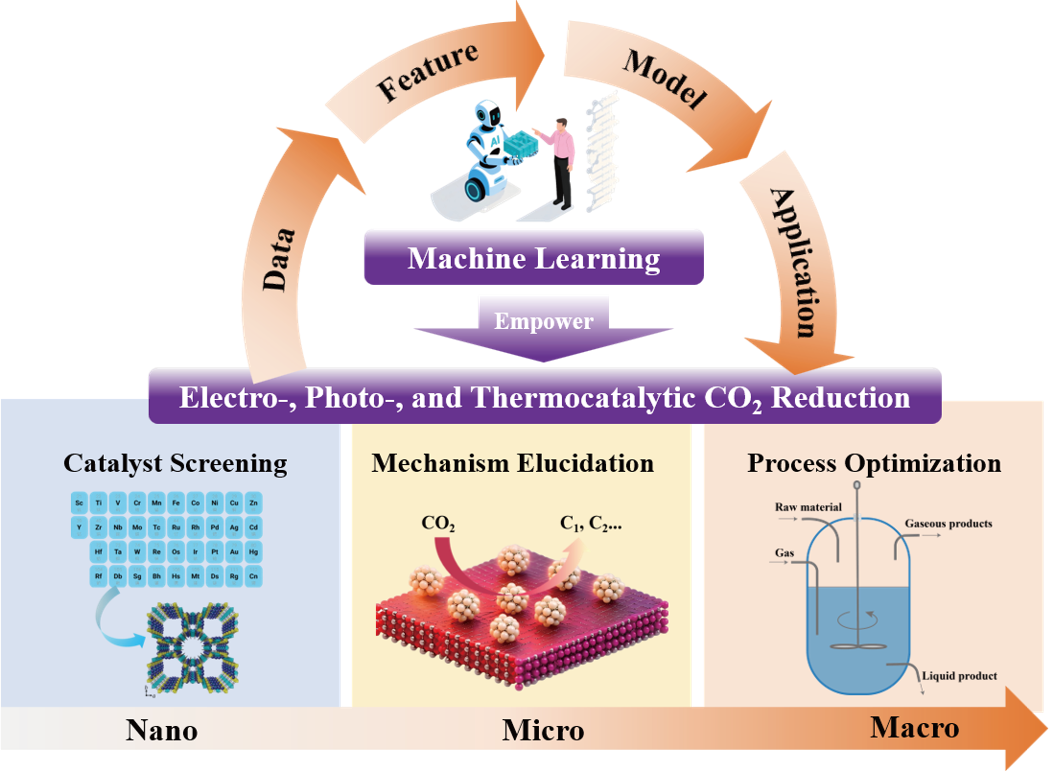
CO2 conversion and usage are integral strategies for mitigating environmental pressure worldwide and reducing energy scarcity. However, traditional research on CO2 reduction faces inherent limitations, including sluggish reaction kinetics, inadequate selectivity, and inefficient development cycles. Driven by the need to overcome these bottlenecks, particularly the slow pace of discovery, machine learning (ML) has reshaped the research landscape. As a data-driven methodology, ML provides powerful predictive and data-mining capabilities that accelerate progress. This review methodically recapitulates the progress in the implementation of ML for CO2 reduction. First, the fundamental theoretical frameworks and technical systems of ML were elucidated. Subsequently, the ML-driven design and high-throughput screening of catalysts, emphasizing the pivotal role of ML in regulating catalyst structure, tailoring composition, and enhancing catalytic performance, were discussed. Moreover, the implementation of ML to elucidate the mechanism of the CO2 reduction reaction and to optimize reaction systems was also summarized. Finally, industrial application scenarios and the existing limitations of ML in CO2 reduction were proposed, along with prospective development directions. This review provides an exhaustive overview of the interdisciplinary intersection between ML and CO2 reduction, delivering substantial insights to expedite the advancement of high-efficiency CO2 conversion technologies.




- Address: Fuzhou High & New Technology Industrial Zone, Shangjie, Minhou, Fuzhou, Fujian 350108, China
- Tel: (86)-591-63173769, 63173770
- E-mail: cjsc@fjirsm.ac.cn
CN 35–1112/TQ, ISSN 0254–5861, Online ISSN: 2949-768X Copyright @ 2022 Chinese Journal of Structural Chemistry-www.Chinese Journal of Structural Chemistry.net. All Rights Reserved 闽ICP备2022002645号-1