


Cover Picture
Ir/Ni–N–C electrocatalyst with promoted CO-tolerance towards alkaline hydrogen oxidation reaction
Yiming Jin, Mingming Pan, and Wei Luo* Submit a Manuscript
Ir/Ni–N–C electrocatalyst with promoted CO-tolerance towards alkaline hydrogen oxidation reaction
Yiming Jin, Mingming Pan, and Wei Luo* Submit a Manuscript
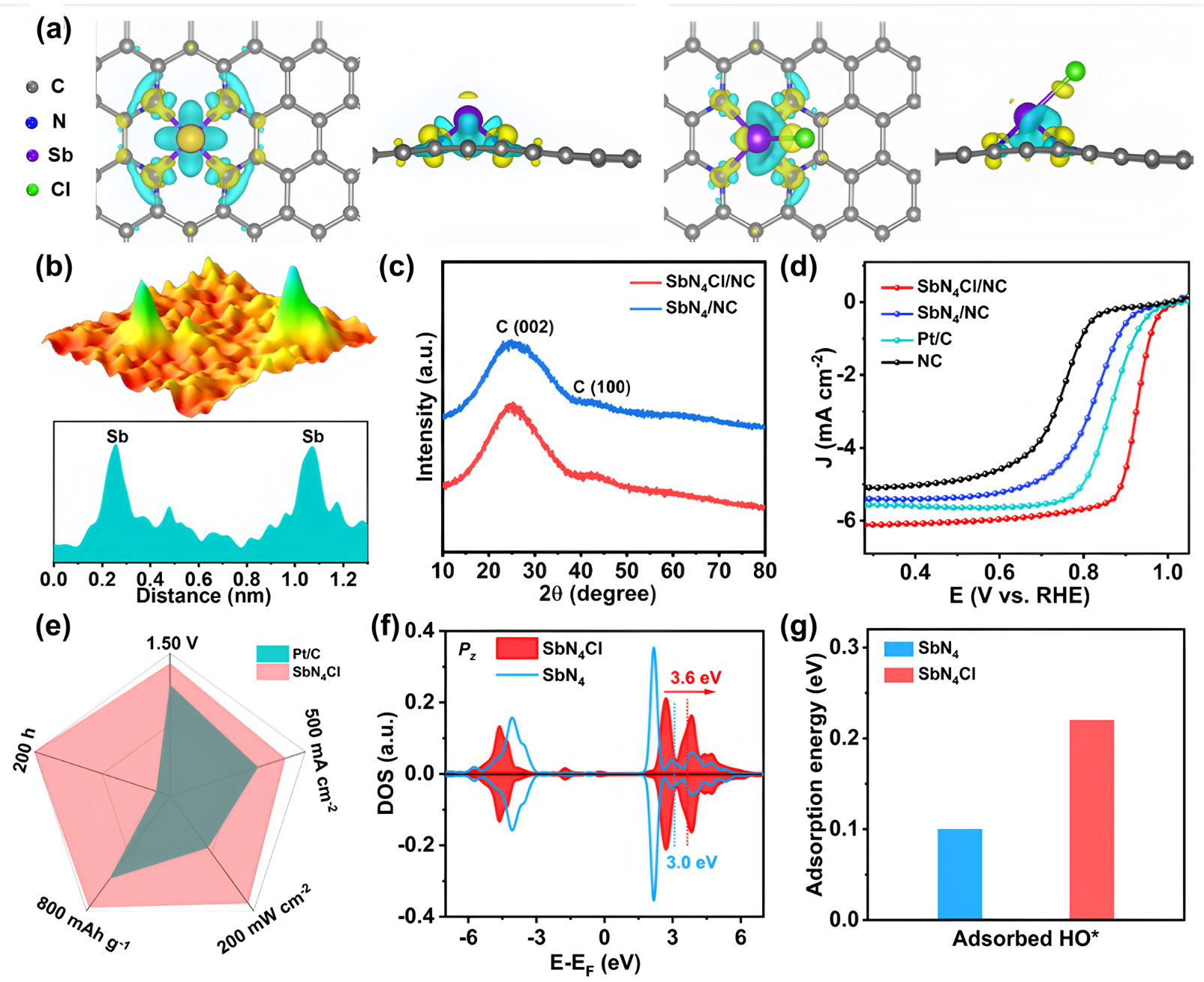
Enhanced oxygen reduction through axial chlorine engineering of p-block antimony atomic sites
Wenjie Zhang, Jiong Zhou*
Chin. J. Struct. Chem., 2026, 45(1), 100732. DOI: 10.1016/j.cjsc.2025.100732
January 1, 2026
ABSTRACT
In
summary, Li, Chen, Yang and co-workers successfully constructed atomically
dispersed Sb active sites on the hierarchical mesoporous carbon framework via a molten chloride salt-assisted pyrolysis strategy, forming a unique SbN4–Cl
coordination structure. This innovative design effectively regulated the
electronic structure of the Sb center through the introduction of an axial
chlorine ligand, optimizing the p-band distribution and significantly reducing
the adsorption energy of key intermediates such as HO*, thereby
enhancing the kinetic rate and overall catalytic efficiency of the ORR. This
study not only overcomes the inherent limitation of low catalytic activity
commonly observed in main-group metal catalysts but also greatly expands their
application prospects in energy conversion systems such as fuel cells and
metal–air batteries. Moreover, it provides new theoretical guidance and design
strategies for tuning the p-band structure of main-group metal SACs through precise coordination engineering. However,
the air electrode in zinc-air batteries is simultaneously governed by the
oxygen evolution reaction (OER) and ORR during charge-discharge cycling. Therefore,
the development of main-group metal catalysts with bifunctional ORR and OER
activity in both acidic and alkaline environments is essential. In addition,
from a practical perspective, substantial improvements in the long-term cycling
stability and overall durability of electrode materials in zinc-air batteries
are imperative.




- Address: Fuzhou High & New Technology Industrial Zone, Shangjie, Minhou, Fuzhou, Fujian 350108, China
- Tel: (86)-591-63173769, 63173770
- E-mail: cjsc@fjirsm.ac.cn
CN 35–1112/TQ, ISSN 0254–5861, Online ISSN: 2949-768X Copyright @ 2022 Chinese Journal of Structural Chemistry-www.Chinese Journal of Structural Chemistry.net. All Rights Reserved 闽ICP备2022002645号-1