


Cover Picture
Chiral europium-organotin oxo-clusters with dual-emission circularly polarized luminescence
Gui-Xin Yan, Er-Xia Chen, Jin-Xia Yang, Jian Zhang*, Qipu Lin * Submit a Manuscript
Chiral europium-organotin oxo-clusters with dual-emission circularly polarized luminescence
Gui-Xin Yan, Er-Xia Chen, Jin-Xia Yang, Jian Zhang*, Qipu Lin * Submit a Manuscript
Ultrathin transparent metal-organic framework-based nanocomposite membranes for antibacterial wound healing
Zhiqi Hu#, Lingling Wu#, Duo Zhang, Yixue An, Jiao Wang*, Binbin Zhao*, Robert Chunhua Zhao, Rong Cao, Xue Yang*
Chin. J. Struct. Chem., 2025, 44(12), 100749. DOI: 10.1016/j.cjsc.2025.100749
December 1, 2025
Metal-organic frameworks; Antibacterial; Wound healing
ABSTRACT
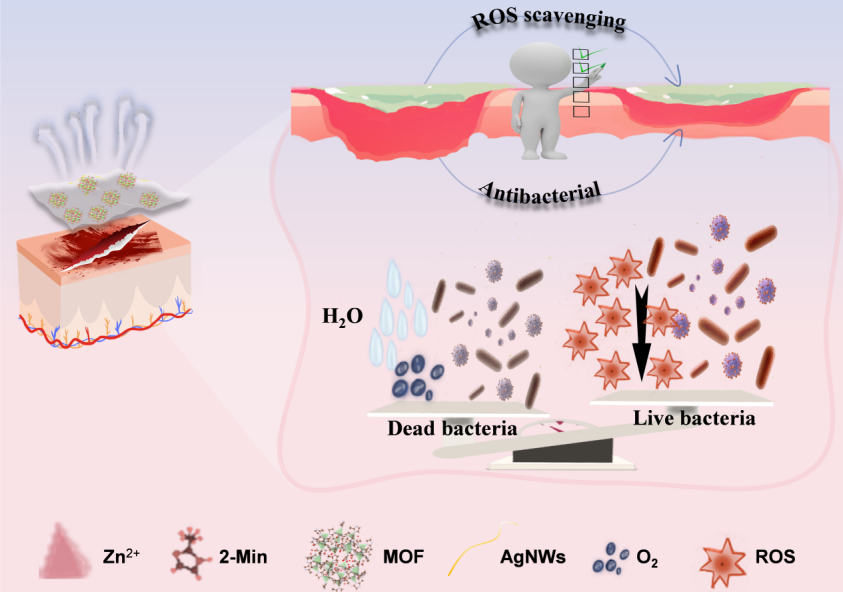
Metal-organic frameworks (MOFs) hold great promise for wound healing applications due to their high surface area, tunable pore structures, and tailored functionalities. However, a significant challenge lies in transforming pristine MOFs powders into ultrathin and flexible dressings that are compatible with soft biological systems. The current limitations of MOFs in practical usability and versatility hinder their integration into advanced wound dressings. Herein, we integrate MOF (ZIF-8) with an ultrathin cellulose membrane to form MOF-based matrix membranes (MMMs) that exhibit high transparency, exceptional mechanical stability, and satisfactory antimicrobial functionality for effective bacterial wound healing. The resulting MMMs can be fabricated into multifunctional dressings of various shapes and sizes, optimized for tissue applications, while maintaining excellent water-vapor permeability and patient compliance. Both in vitro and in vivo experiments demonstrated that the MMMs exhibit outstanding biocompatibility, antibacterial activity, and antioxidant properties, significantly accelerating the healing of bacterial-infected wounds. This work presents a transformative approach to wound care, establishing a foundation for next-generation dressings that combine the multifunctionality of MOFs with the mechanical and biological compatibility required for clinical applications.




- Address: Fuzhou High & New Technology Industrial Zone, Shangjie, Minhou, Fuzhou, Fujian 350108, China
- Tel: (86)-591-63173769, 63173770
- E-mail: cjsc@fjirsm.ac.cn
CN 35–1112/TQ, ISSN 0254–5861 Copyright @ 2022 Chinese Journal of Structural Chemistry-www.Chinese Journal of Structural Chemistry.net. All Rights Reserved 闽ICP备2022002645号-1