


Cover Picture
Ir/Ni–N–C electrocatalyst with promoted CO-tolerance towards alkaline hydrogen oxidation reaction
Yiming Jin, Mingming Pan, and Wei Luo* Submit a Manuscript
Ir/Ni–N–C electrocatalyst with promoted CO-tolerance towards alkaline hydrogen oxidation reaction
Yiming Jin, Mingming Pan, and Wei Luo* Submit a Manuscript
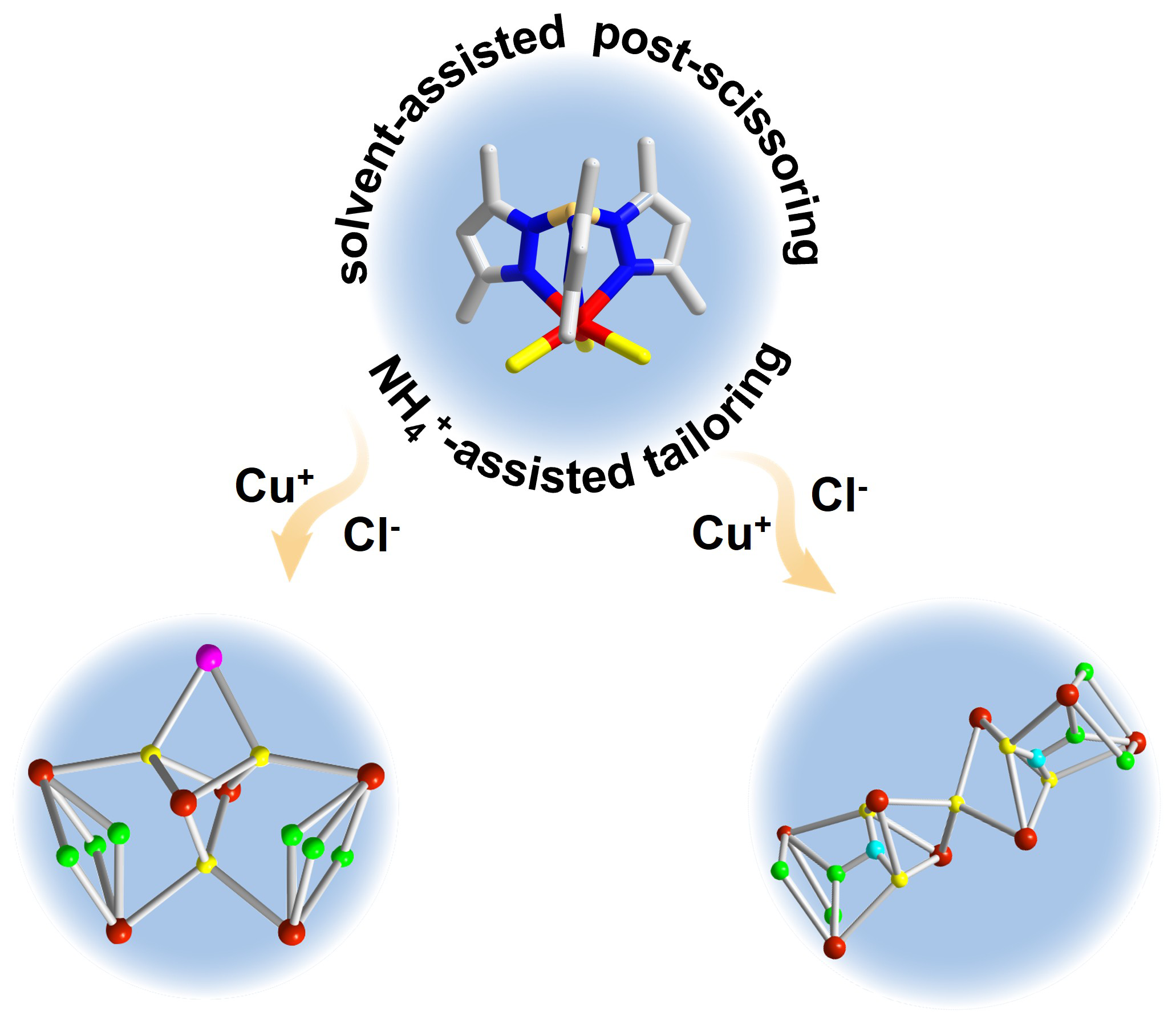
Molecular tailoring strategies for the controlled assembly of high-nuclearity sulfide-bridged metal clusters
Lao-Bang Wang1, Yaoyao Peng1, Yu Fang*, Jian-Ping Lang*
Chin. J. Struct. Chem., 2026, 45(1), 100768. DOI: 10.1016/j.cjsc.2025.100768
January 1, 2026
Metal sulfur clusters; Molecular tailoring strategy; Synergistic linking; Topological structure; Third-order nonlinear optical responses
ABSTRACT
Metal sulfide-bridged clusters exhibit unique topologies and functional properties, offering potential for advanced materials and biomimetic systems. However, challenges persist in their controlled synthesis, particularly in precise sulfide incorporation and structural modulation to form high-nuclearity clusters. Herein, we report an in-situ molecular tailoring strategy using protonation of the [Tp*WS3]- synthon by NH4+ to gradually release S2- ions, which react with in situ formed fragments such as [Tp*WS3Cu3]2+ and [Tp*WS3Cu2]+. Under the cooperative influence of Cl-, CN-, or Cu+, three low-nuclearity clusters with complex polyhedral structures are assembled. Solvent-induced post-scissoring and reassembly of these precursors afford two unprecedented high-nuclearity clusters with novel topological frameworks. Thin films derived from single crystals of all five clusters display significantly enhanced third-order nonlinear optical (NLO) responses compared to their solution-state counterparts. Importantly, the high-nuclearity clusters display NLO responses surpassing not only those of their precursors but also the additive contributions of the individual units. Density functional theory (DFT) calculations attribute this enhancement to improved intracluster charge separation and synergistic interactions via linkers. This work establishes a versatile platform for constructing high-nuclearity metal sulfide clusters and provides new insights into designing functional analogues of nitrogenase-active sites.




- Address: Fuzhou High & New Technology Industrial Zone, Shangjie, Minhou, Fuzhou, Fujian 350108, China
- Tel: (86)-591-63173769, 63173770
- E-mail: cjsc@fjirsm.ac.cn
CN 35–1112/TQ, ISSN 0254–5861, Online ISSN: 2949-768X Copyright @ 2022 Chinese Journal of Structural Chemistry-www.Chinese Journal of Structural Chemistry.net. All Rights Reserved 闽ICP备2022002645号-1