


Cover Picture
Ir/Ni–N–C electrocatalyst with promoted CO-tolerance towards alkaline hydrogen oxidation reaction
Yiming Jin, Mingming Pan, and Wei Luo* Submit a Manuscript
Ir/Ni–N–C electrocatalyst with promoted CO-tolerance towards alkaline hydrogen oxidation reaction
Yiming Jin, Mingming Pan, and Wei Luo* Submit a Manuscript
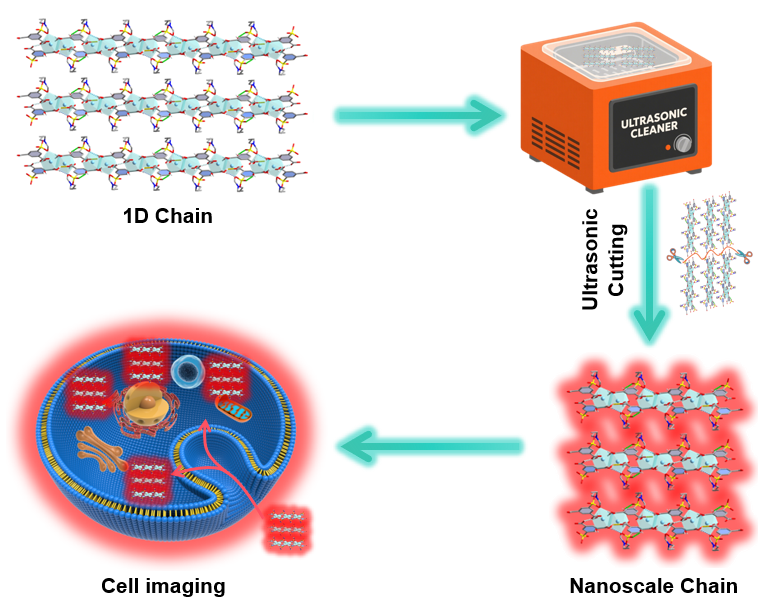
Ultrasonic cutting strategy yields lanthanide organic nanochains with bright emission: thermally enhanced luminescence and bio-optical imaging
Fan Yang, Guan‐Huang Zhang, Hai-Ling Wang*, Wen-Wen Qin, Zhong-Hong Zhu*, Fu-Pei Liang, Hua-Hong Zou*
Chin. J. Struct. Chem., 2026, 45(1), 100761. DOI: 10.1016/j.cjsc.2025.100761
January 1, 2026
Lanthanide complexes; Antenna effect; Solvothermal synthesis; Thermally enhanced luminescence; Lanthanide one-dimensional chains
ABSTRACT
In this work, an ultrasonic tailoring strategy was used to obtain nanosized one-dimensional chain-like lanthanide metal-organic frameworks (Ln-MOFs) with excellent photophysical properties for the first time, and high-resolution bio-optical imaging applications were achieved. As the ambient temperature gradually increases, the chain-like Ln-MOFs do not show obvious thermal quenching of luminescence. It is worth noting that when the ambient temperature exceeds 300 K, the departure of the terminal-coordinated H2O molecules within the Ln-MOFs structure induces significant thermally enhanced luminescence. Furthermore, by regulating the energy transfer pathways of bimetallic-doped TbxEu(1-x)-MOFs, a series of luminescence changes from yellow-green to red were achieved. Based on the multiple excitation, thermally enhanced luminescence, and multicolor luminescence properties of Ln-MOFs, a complex anti-counterfeiting system was constructed. More noteworthy is that the Ln-MOFs nanochains obtained using the ultrasonic cutting strategy have high-resolution optical imaging effects on HeLa, MCF-7, MDA-MB-231 cells and living zebrafish, and can specifically label the lysosomes of living cells. This work opens up new horizons for the application of multidimensional lanthanide complex emitters in high-resolution bio-optical imaging and opens a new blueprint for constructing lanthanide complex emitters with "all-in-one" functions.




- Address: Fuzhou High & New Technology Industrial Zone, Shangjie, Minhou, Fuzhou, Fujian 350108, China
- Tel: (86)-591-63173769, 63173770
- E-mail: cjsc@fjirsm.ac.cn
CN 35–1112/TQ, ISSN 0254–5861, Online ISSN: 2949-768X Copyright @ 2022 Chinese Journal of Structural Chemistry-www.Chinese Journal of Structural Chemistry.net. All Rights Reserved 闽ICP备2022002645号-1