


Cover Picture
MOF derived Co–Mo2C heterojunctions with interfacial electronic modulation for oxygen reduction reaction and zinc-air batteries
Desheng Li#, Qin Li#, Peng Xu, Xingyu Guo, Heng Wu, Rui Liu*, Fei Tan* Submit a Manuscript
MOF derived Co–Mo2C heterojunctions with interfacial electronic modulation for oxygen reduction reaction and zinc-air batteries
Desheng Li#, Qin Li#, Peng Xu, Xingyu Guo, Heng Wu, Rui Liu*, Fei Tan* Submit a Manuscript
MOF-derived carbon-encapsulated ZnS/MnO porous microspheres for high-performance lithium storage
Jiamin Xiong1, Baiying Huang1, Yuling Zhang , Kaixin Zhou, Yuxuan Liu, Shengen Gong*, Zhiguang Xu*, Yongbo Wu, Akif Zeb*, Xiaoming Lin*
Chin. J. Struct. Chem., 2026, 45(2), 100795. DOI: 10.1016/j.cjsc.2025.100795
February 1, 2026
Lithium-ion battery; Anode materials; MOFs templated method; ZnS/MnO composites; Density functional theory calculation
ABSTRACT
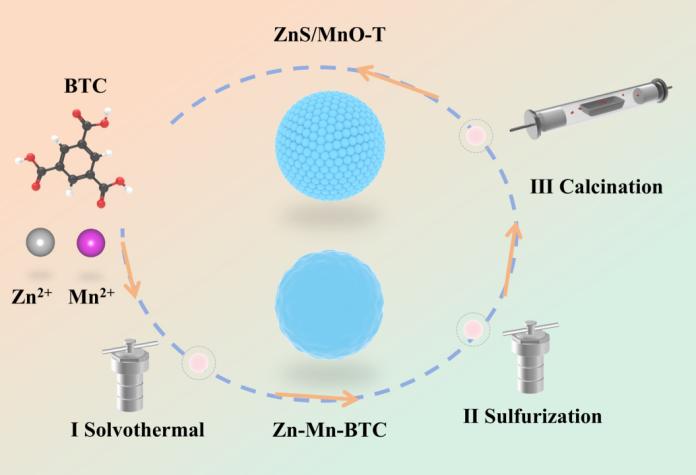
The advantages of transition metal compounds such as ultrahigh theoretical capacity and abundant active sites make them promising anode materials for high energy density lithium-ion batteries. Unfortunately, problems such as severe volume expansion and poor electrical conductivity seriously hinder their large-scale application. In general, reasonable optimization of composition and structure is an effective strategy for developing anode materials with excellent lithium storage properties. In this paper, ZnS/MnO composites were constructed by solvothermal sulfidation and calcination using Zn-Mn organic frameworks as self-sacrificing templates. From the perspective of material composition, both ZnS and MnO have excellent theoretical specific capacity, and the two-component metal center can provide more abundant active sites. From the perspective of structural optimization, the ZnS/MnO composites inherit the loose porous structure of the calcined metal-organic frameworks, which can not only effectively alleviate the volume expansion during the charge and discharge process, but can also help improve the conductivity of the composites and promote charge transport. Both experimental results and density functional theory calculations show that the two-component metal center of ZnS/MnO composites can improve the electronic conductivity and reduce the migration energy barrier, thus showing excellent cycle stability and remarkable rate performance. The study provides another idea for the development of high-performance anode materials for lithium-ion batteries.




- Address: Fuzhou High & New Technology Industrial Zone, Shangjie, Minhou, Fuzhou, Fujian 350108, China
- Tel: (86)-591-63173769, 63173770
- E-mail: cjsc@fjirsm.ac.cn
CN 35–1112/TQ, ISSN 0254–5861, Online ISSN: 2949-768X Copyright @ 2022 Chinese Journal of Structural Chemistry-www.Chinese Journal of Structural Chemistry.net. All Rights Reserved 闽ICP备2022002645号-1