


MOF derived Co–Mo2C heterojunctions with interfacial electronic modulation for oxygen reduction reaction and zinc-air batteries
Desheng Li#, Qin Li#, Peng Xu, Xingyu Guo, Heng Wu, Rui Liu*, Fei Tan* Submit a Manuscript
Desheng Li#, Qin Li#, Peng Xu, Xingyu Guo, Heng Wu, Rui Liu*, Fei Tan*
Chin. J. Struct. Chem., 2026, 45(2), 100796. DOI: 10.1016/j.cjsc.2025.100796
February 1, 2026
MOF; Catalysis; Heterojunction; Oxygen reduction reaction; Zn-air batteries
ABSTRACT
Zinc-air batteries (ZABs) have emerged as promising
candidates for next-generation energy storage systems due to their high energy
density, safety, and environmental benignity. However, their efficiency is hindered by
sluggish oxygen reduction reaction (ORR) kinetics. Constructing heterojunction
with optimized interfacial electronic structure has emerged as a promising
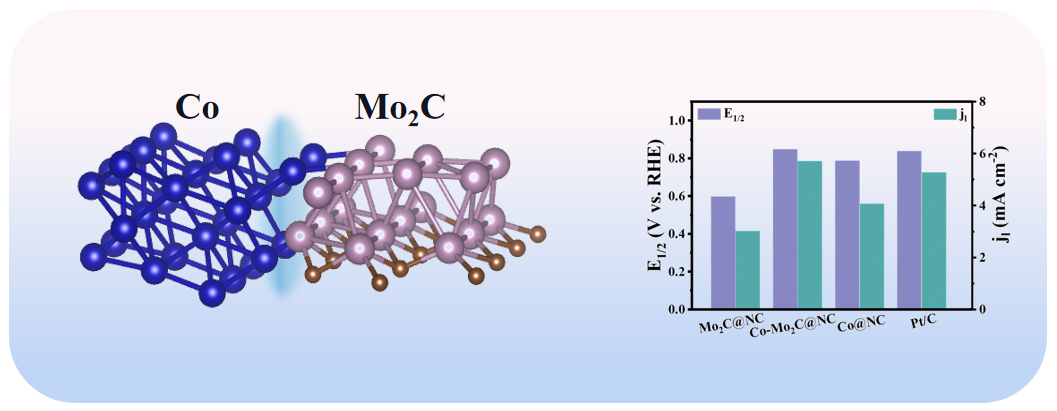
approach to enhance ORR activity. Herein, we report a Co–Mo2C
heterojunction encapsulated within nitrogen-doped carbon (Co–Mo2C@NC)
derived from a ZnCoMo-based metal–organic framework (ZnCoMo–HZIF). The intimate
interface between Co and Mo2C enables the strong electronic
coupling, which induces the interfacial charge redistribution and optimizes the
d-band center of Co active sites. This electronic modulation significantly
enhances the oxygen intermediate adsorption and lowers the energy barrier. As a
result, Co–Mo2C@NC delivers outstanding ORR performance with a high
half-wave potential (E1/2) of 0.85 V, a low Tafel slope of
94.7 mV dec-1, and a good long-term stability. Additionally, Co–Mo2C@NC
as the air cathode in a zinc-air battery exhibits superior power performance
and outstanding cycling stability.




- Address: Fuzhou High & New Technology Industrial Zone, Shangjie, Minhou, Fuzhou, Fujian 350108, China
- Tel: (86)-591-63173769, 63173770
- E-mail: cjsc@fjirsm.ac.cn