


Cover Picture
Fast hydrogenolytic debenzylation enabled by hierarchically ordered porosity and accessibly rich Pd(0) sites
Zhe Li, Gui-Long Wang, Xin Feng, Jia-Hui Guo, Lu Bai, Jie Chen*, Ming-Shui Yao* Submit a Manuscript
Fast hydrogenolytic debenzylation enabled by hierarchically ordered porosity and accessibly rich Pd(0) sites
Zhe Li, Gui-Long Wang, Xin Feng, Jia-Hui Guo, Lu Bai, Jie Chen*, Ming-Shui Yao* Submit a Manuscript
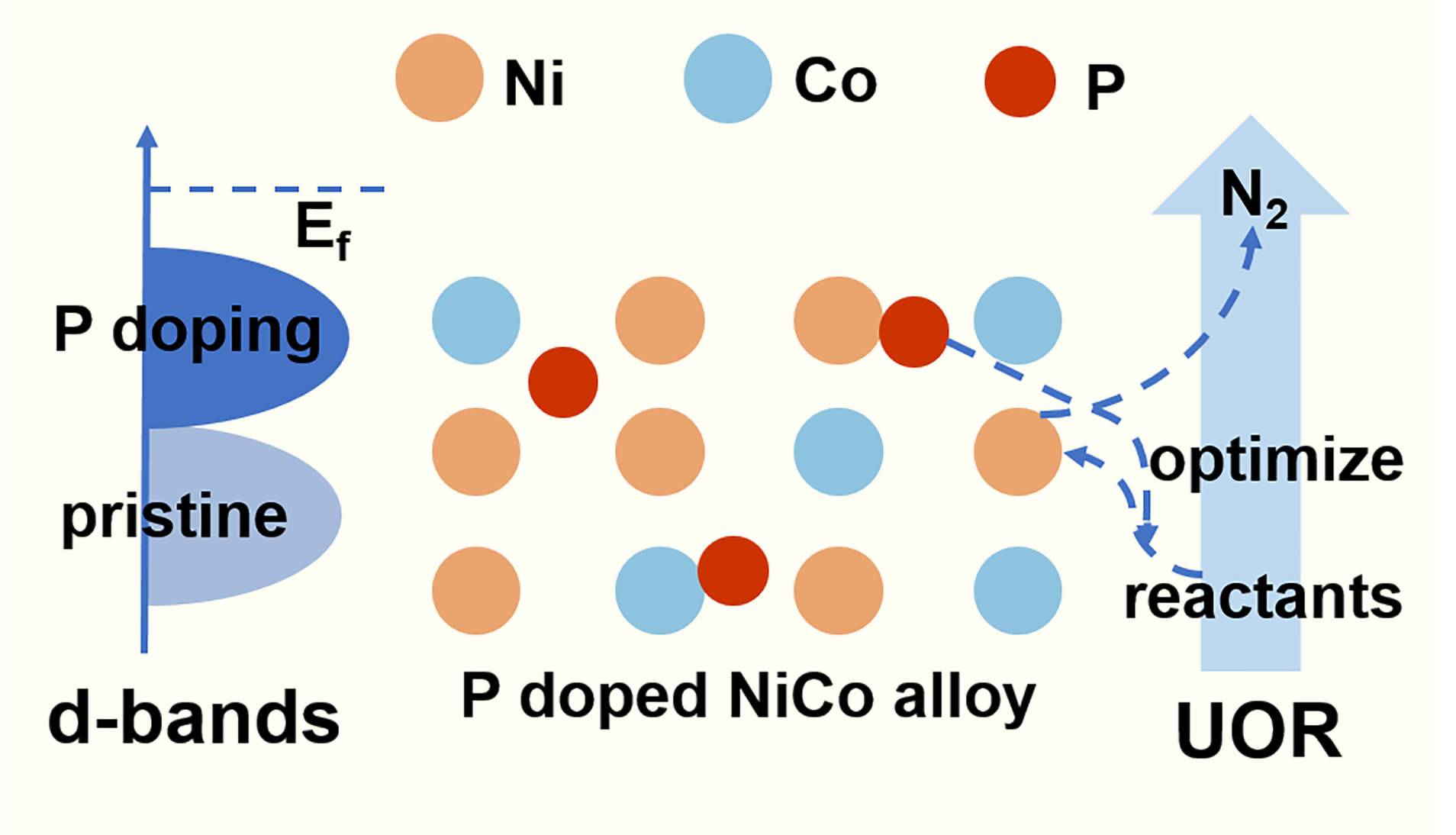
Tuning the d-band center of amorphous NiCo alloy via P doping for enhanced urea electrolysis
Wenjie Jiang, Jiali Lu, Jia Wu, Boyao Feng, Zhixiang Zhai, Huan Wen, Shibin Yin*
Chin. J. Struct. Chem., 2026, 45(5), 100865. DOI: 10.1016/j.cjsc.2026.100865
May 1, 2026
Phosphorus doping; Amorphous NiCo alloy; Reactant adsorption; Urea oxidation reaction; Hydrogen evolution reaction
ABSTRACT
Nickel-cobalt (NiCo) alloys with bimetallic electronic modulation are considered promising candidates for urea electrolysis. However, their highly occupied d-band states limit the adsorption of reaction intermediates, resulting in insufficient activity toward urea oxidation reaction (UOR) and hydrogen evolution reaction (HER). Herein, a phosphorus-doped amorphous NiCo alloy is synthesized, in which P incorporation modulates the electronic structure and upshifts the d-band center of NiCo alloy, thus optimizing the adsorption of OH− and urea molecules. The sample with optimal P content exhibits low potentials for UOR (E10/1000 = 1.28/1.65 VRHE) and HER (E−10/−1000 = −67/−206 mVRHE). Furthermore, it achieves an industrial-level current density of 500 mA cm−2 at a cell voltage of 1.72 V in the membrane electrode assembly, while maintaining stable activity for 150 h. Therefore, this work provides a new strategy to optimize reactant adsorption and ultimately enhance the electrocatalytic activity by modulating the d-band center.




- Address: Fuzhou High & New Technology Industrial Zone, Shangjie, Minhou, Fuzhou, Fujian 350108, China
- Tel: (86)-591-63173769, 63173770
- E-mail: cjsc@fjirsm.ac.cn
CN 35–1112/TQ, ISSN 0254–5861, Online ISSN: 2949-768X Copyright @ 2022 Chinese Journal of Structural Chemistry-www.Chinese Journal of Structural Chemistry.net. All Rights Reserved 闽ICP备2022002645号-1