


Cover Picture
Fast hydrogenolytic debenzylation enabled by hierarchically ordered porosity and accessibly rich Pd(0) sites
Zhe Li, Gui-Long Wang, Xin Feng, Jia-Hui Guo, Lu Bai, Jie Chen*, Ming-Shui Yao* Submit a Manuscript
Fast hydrogenolytic debenzylation enabled by hierarchically ordered porosity and accessibly rich Pd(0) sites
Zhe Li, Gui-Long Wang, Xin Feng, Jia-Hui Guo, Lu Bai, Jie Chen*, Ming-Shui Yao* Submit a Manuscript
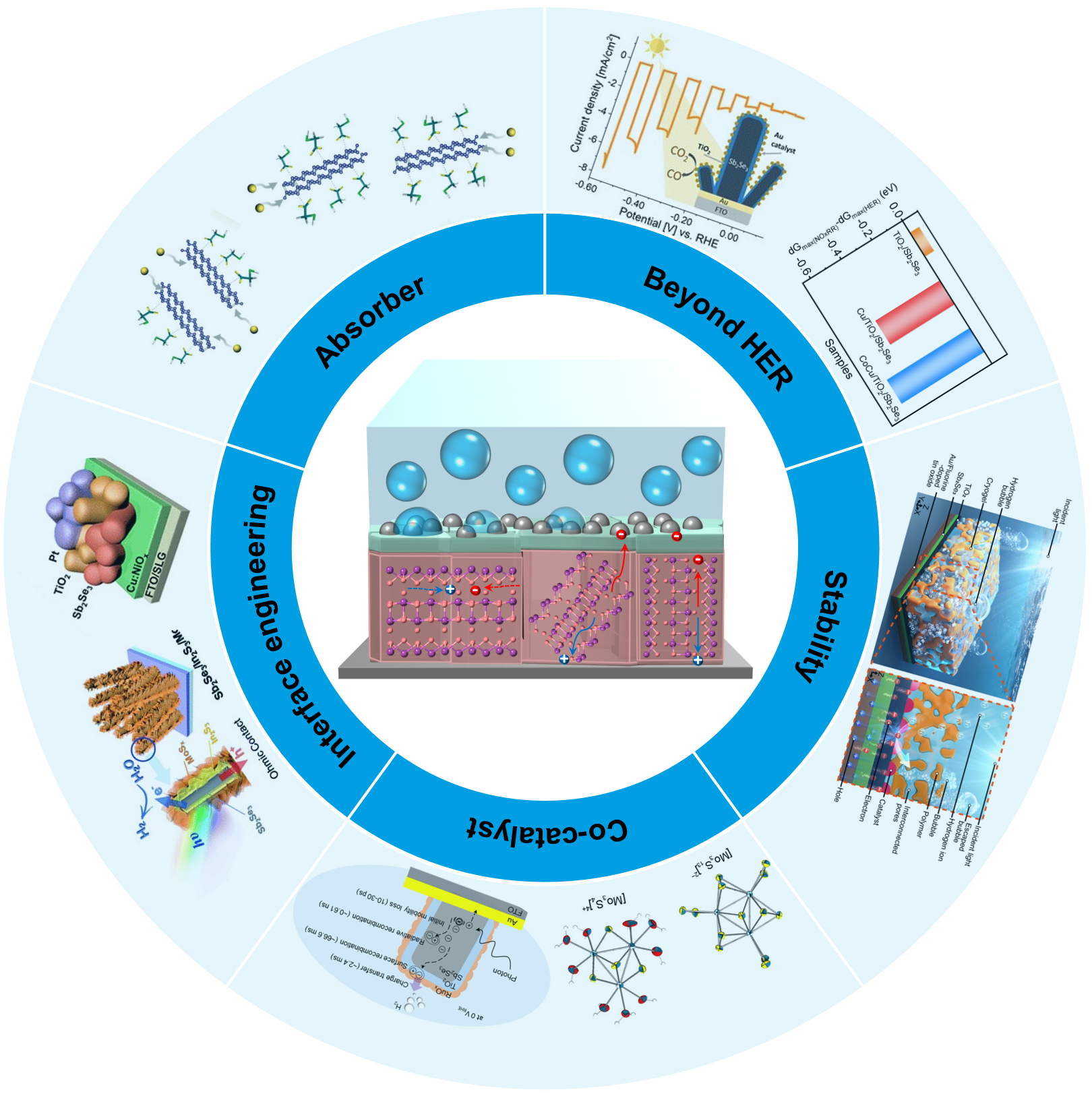
Quasi-one-dimensional antimony selenide photocathodes: From fundamentals to future direction
Ziying Zhang, Xiangjiu Guan*, Liejin Guo*
Chin. J. Struct. Chem., 2026, 45(5), 100864. DOI: 10.1016/j.cjsc.2026.100864
May 1, 2026
Antimony selenide; Quasi-one-dimensional; Photoelectrochemistry; Interface engineering; Solar-to-fuel
ABSTRACT
Antimony selenide (Sb2Se3) has emerged as a promising absorbing material in photocathode for photoelectrochemical (PEC) hydrogen evolution, exhibiting a development trajectory that outpaces many traditional semiconductors. Despite growing research interest, few reviews have provided a comprehensive roadmap for this class of photocathodes. In this review, starting from the scope and fundamentals of PEC systems, we will introduce how the quasi-one-dimensional (1D) crystal structure of Sb2Se3 enables anisotropic carrier transport, benign grain boundaries, and intrinsic stability. Advances in both vacuum and solution-based deposition techniques have yielded high-quality and scalable thin films, while recent progress in crystal orientation control, interface engineering, and co-catalyst integration has markedly improved efficiency. In parallel, the application of protection layers and bubble management strategies has extended operational stability. Beyond hydrogen evolution, Sb2Se3 has also shown potential for alternative solar-driven reactions. Nevertheless, challenges such as defect-induced recombination, interfacial mismatches, and long-term durability remain critical bottlenecks. Future progress will rely on integrated efforts in interface engineering, defect and crystal quality control, advanced protection and bubble management strategies, and the development of earth-abundant co-catalysts for alternative reactions, thereby linking fundamental material optimization with practical device deployment in solar-to-fuel technologies.




- Address: Fuzhou High & New Technology Industrial Zone, Shangjie, Minhou, Fuzhou, Fujian 350108, China
- Tel: (86)-591-63173769, 63173770
- E-mail: cjsc@fjirsm.ac.cn
CN 35–1112/TQ, ISSN 0254–5861, Online ISSN: 2949-768X Copyright @ 2022 Chinese Journal of Structural Chemistry-www.Chinese Journal of Structural Chemistry.net. All Rights Reserved 闽ICP备2022002645号-1