


Cover Picture
Ir/Ni–N–C electrocatalyst with promoted CO-tolerance towards alkaline hydrogen oxidation reaction
Yiming Jin, Mingming Pan, and Wei Luo* Submit a Manuscript
Ir/Ni–N–C electrocatalyst with promoted CO-tolerance towards alkaline hydrogen oxidation reaction
Yiming Jin, Mingming Pan, and Wei Luo* Submit a Manuscript
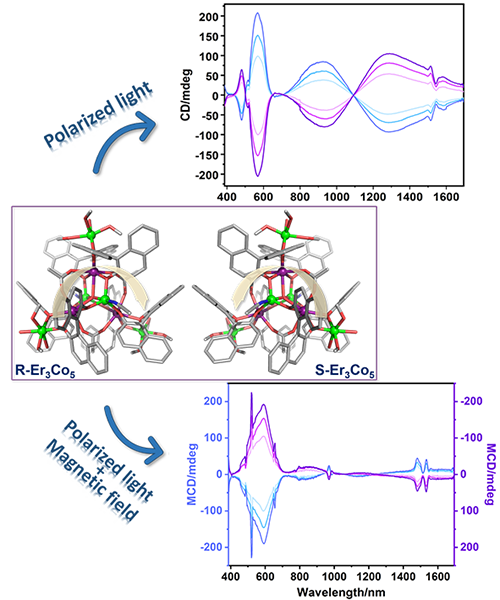
Chiral Ln3Co5 clusters with geometry-dependent chiroptical and magneto-optical properties
Ya-Xuan Xue, Han Xu, Jia-Nan Chen, Hai-Quan Tian, Tao Jia, Wei-Dong Liu, Chong-Yang Li, La-Sheng Long, Lan-Sun Zheng, Xiang-Jian Kong*
Chin. J. Struct. Chem., 2026, 45(1), 100764. DOI: 10.1016/j.cjsc.2025.100764
January 1, 2026
Circular dichroism; Magnetic circular dichroism; Ligand field; Chiroptical behavior
ABSTRACT
Heterometallic 3d-4f clusters represent a promising class of multifunctional molecular materials, driven by the synergistic interactions between d- and f-electrons. Incorporating chirality into these systems further expands their potential applications, particularly in chiroptical and magneto-optical technologies. Herein, we report the successful synthesis of chiral [Ln3Co5] (Ln = Er and Y) clusters using binaphthol-based ligands. Single-crystal X-ray diffraction reveals the coexistence of two distinct Co2+ coordination geometries: six-coordinate octahedral and five-coordinate trigonal bipyramidal. Spectroscopic analyses demonstrate geometry-dependent chiroptical behavior: pentacoordinate Co2+ ions predominantly contribute to the circular dichroism (CD) features, while both geometries exhibit distinguishable signals in the magnetic circular dichroism (MCD) spectra. Notably, a pronounced magnetic dipole transition (4I15/2 → 4I13/2) from Er3+ centers is observed in the near-infrared MCD region, displaying a high g-factor of 0.0078 T-1. This work highlights the configuration- and ligand field-dependent chiroptical responses in 3d-4f systems, providing new insights for the rational design of advanced magneto-optical devices.




- Address: Fuzhou High & New Technology Industrial Zone, Shangjie, Minhou, Fuzhou, Fujian 350108, China
- Tel: (86)-591-63173769, 63173770
- E-mail: cjsc@fjirsm.ac.cn
CN 35–1112/TQ, ISSN 0254–5861, Online ISSN: 2949-768X Copyright @ 2022 Chinese Journal of Structural Chemistry-www.Chinese Journal of Structural Chemistry.net. All Rights Reserved 闽ICP备2022002645号-1